
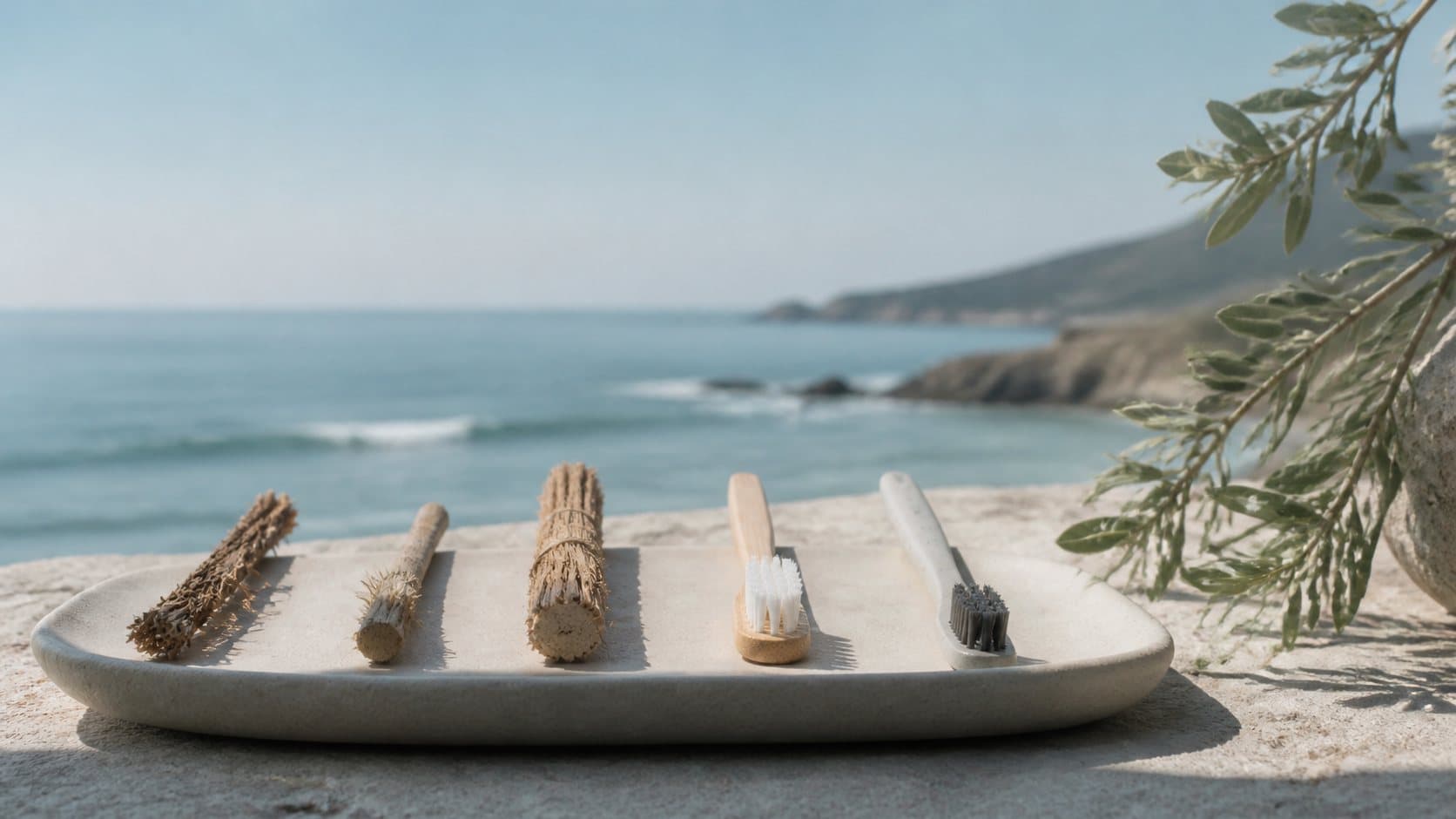
The chew stick
References to chewing soft sticks for dental cleaning appear on Babylonian cuneiform tablets dated to roughly 3500 of the prior era. The same practice shows up in ancient Egyptian, Greek, and Roman sources. The technology was simple. Choose a stick from a tree with naturally fibrous wood, fray one end with the teeth, use the frayed end to clean.
The selection of tree mattered. Some species had antibacterial properties, mild aromatic oils, or fibers that resisted matting. The chew stick was not a universal stick. It was a curated tool, with regional preferences passed down generationally.
The miswak: a tool that never went away
Across the Arabian peninsula, North Africa, and parts of South Asia, the chew stick survived as the miswak. Cut from the salvadora persica tree, the miswak has been used continuously for at least the last fifteen hundred years and remains in daily use today across many parts of the world.
The miswak is more than a folk tradition. It contains naturally occurring compounds with documented antibacterial activity, and several recent dental studies have evaluated it favorably against modern brush designs. It is the rare hygiene tool that has not needed to be replaced.
What that says about the chew stick, more broadly, is that the underlying idea was sound. Five thousand years of iteration have changed the materials, not the principle.

Boar bristle and the medieval West
The first brush-shaped toothbrush, with bristles bound to a handle, is generally credited to seventh-century Tang dynasty China. The bristles came from the back of a hog. The handle was bone or bamboo. The design crossed into Europe slowly, through Silk Road trade.
By the early modern period, boar-bristle brushes were the standard tool of the European elite. They were expensive. They were difficult to keep clean. They needed to be soaked, dried, and replaced often, and they sometimes carried whatever bacteria the boar had carried before becoming a brush.
The mass-market version did not arrive until 1780. An English entrepreneur named William Addis, while serving a prison sentence, drilled holes in a small bone he had saved from a meal, threaded boar bristle through the holes, and sold the result on his release. The company he founded still exists.
Nylon and the modern era
Boar-bristle dependency ended in 1938. DuPont introduced a synthetic bristle, called nylon, that could be manufactured at consistent diameter, sterilized easily, and bound to a handle without the supply-chain complications of animal hair. The first commercial nylon toothbrush, marketed under the name an early nylon-bristle toothbrush, reset the category within a single season.
The electric toothbrush followed in 1954, designed by a Swiss dentist named Philippe-Guy Woog. The original version was corded and intended for patients with limited motor function. By the 1960s, it had become a consumer product. By the 2000s, the rotary and sonic categories had matured into a competitive market.
Each step was a real improvement. Each step also kept the underlying object recognizable. A handle. Bristles. A hand. The underlying geometry has not changed in five thousand years.
It is the rare household object with that kind of continuity. Most things on a modern bathroom shelf would be unrecognizable to anyone living before 1900. The toothbrush would not. A Babylonian dental ritualist, handed a contemporary brush, would understand what to do with it inside a few seconds.
What 5,000 years of brushing teach about routine
The short version is that the daily act mattered more than any one tool. Civilizations brushed with chew sticks for thousands of years, with boar bristle for centuries, with nylon for decades. The tool kept getting better. The compounding effect of consistent daily use is what made the practice protective in the first place.
That is a useful lesson outside the mouth. A routine that holds across decades is not the routine that uses the most premium tool. It is the routine that gets repeated. The quality of the tool decides the ceiling. The quality of the repetition decides the floor.
Most of what looks like progress in personal care is, on a closer read, the same daily act with a different surface material. The act is what carries.