
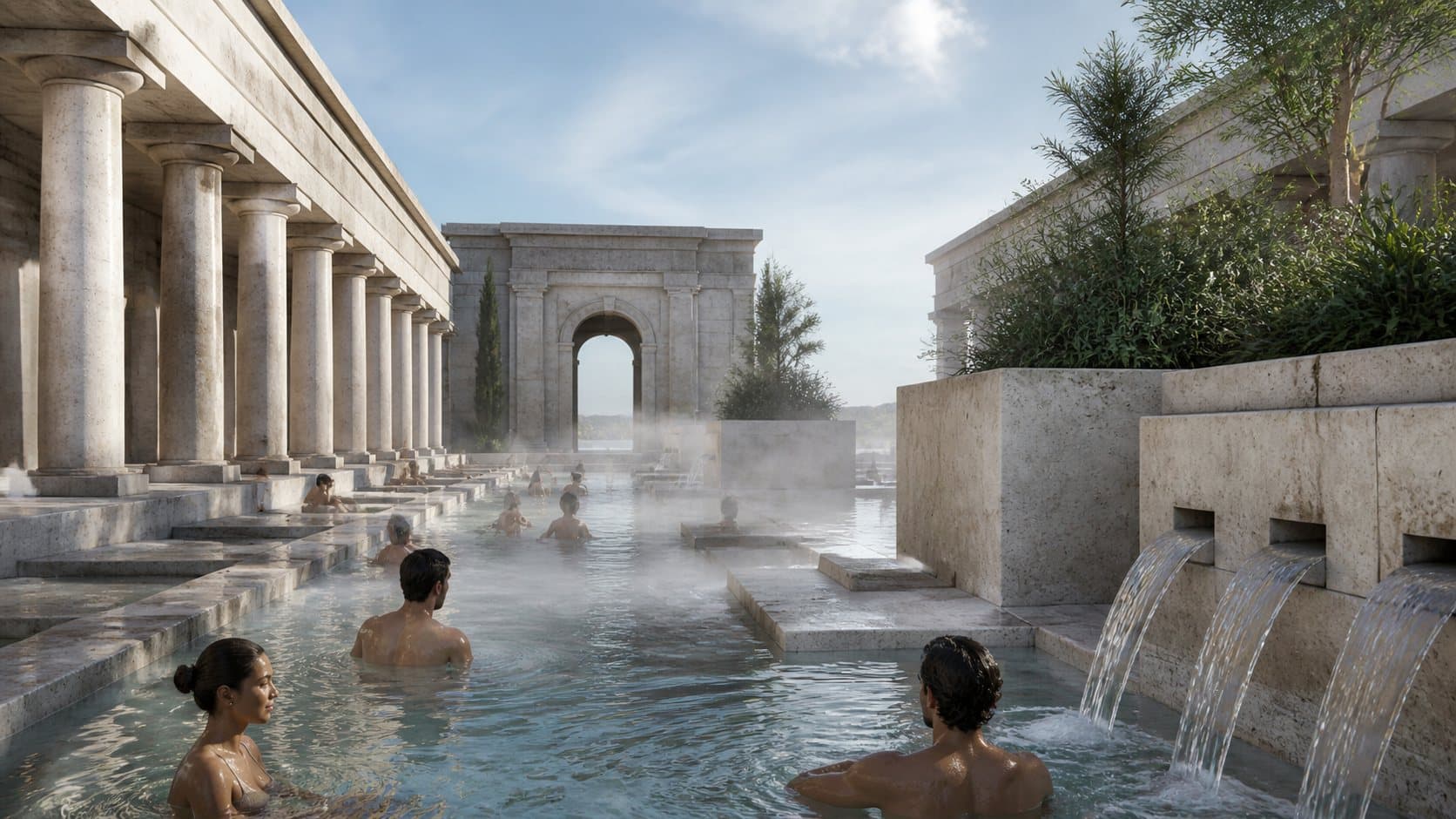
The thermae as architecture
The Baths of Caracalla, completed in Rome around 216 of the common era, covered roughly thirty acres and could hold sixteen hundred bathers at once. The Baths of Diocletian, completed about ninety years later, were larger still. These were not spa buildings. They were public infrastructure on the order of aqueducts.
A bath complex contained a sequence of rooms. The apodyterium for changing, the tepidarium for warming, the caldarium for hot bathing, the frigidarium for cold. Around them were libraries, gardens, exercise yards, and shops. A citizen could spend the better part of a day inside, and many did.
The thermae were free or close to it. They were funded by the state and by individual donors, and admission was almost universal across Roman urban life. A clean body was not a private achievement. It was something the city offered.
What hygiene meant when it was civic
In a society where bathing happened together, hygiene took on different cultural weight than it does today. It was not a moral test. It was not a private discipline. It was a public ritual, somewhere between a city park and a place of business. People conducted negotiations in the baths. They argued, played, courted, exchanged gossip, and read.
The cleanliness was real. So was the social value of being seen as a person who used the baths well. The connection between hygiene and civic membership was direct, not metaphorical. To bathe was, in part, to participate.
It is worth noticing how different that is from the contemporary frame. Today, hygiene tends to read as something a person does behind a closed door, mostly to themselves, and is judged on later in public. Roman hygiene was the reverse. Public during, private after.

The slow privatization
The fall of the Western Roman empire took the thermae with it, more or less. Public bathing did not disappear from the medieval period entirely. Bathhouses operated in many European cities and across the Islamic world, where the hammam continued the lineage with a different vocabulary.
By the late Middle Ages, Western European public bathing reputation had suffered. Plague years and shifting religious attitudes pushed bathing into private quarters. Frequency declined. The clean shirt replaced the clean body in many parts of European life until well into the nineteenth century.
The Industrial Revolution rebuilt public bathing for sanitary reasons rather than civic ones. Working-class districts in cities like London and Manchester gained municipal baths because tenement housing did not have plumbing. The public bath became a public-health intervention, not a social institution.
What the modern bathroom inherited
Twentieth-century plumbing finished the move. The bathroom became a small private room in every house, a kind of architectural consolation for the loss of the public version. The frequency of bathing rose dramatically. The civic and ritual layers did not return with it.
What we inherited is a hybrid. The plumbing of the thermae, scaled down to one person. The privacy of the medieval period, scaled up to a daily occurrence. The cultural meaning of cleanliness as a personal achievement, with all the weight that carries when there is no shared standard around it.
It is a strange arrangement, when you trace it. A daily ritual, conducted alone, judged in public.
Hygiene as ritual, restated
The word ritual gets thrown around loosely in personal-care marketing. The Romans defined it precisely. A ritual is a repeated act, performed in a structured sequence, with cultural weight beyond its physical effect. Bathing in the thermae qualified easily.
Most modern hygiene does not. It has lost the structure and most of the cultural weight. What remains is a series of practical tasks, often performed in a hurry, with a vague sense that they should add up to something more.
Whether that gets restored is not a question for advertising to answer. It is a question of which parts of the routine a person decides to keep, repeat, and hold as essential. The answer is personal. The history just makes the question visible.