
Why formulas should evolve
A formula that has not changed in years is not always a sign of confidence. Sometimes it means the category moved and the formula did not. The category for internal hygiene is young. The science continues to move. A serious formula moves with it.
The harder version of this is that evolving a formula in public requires honesty. New actives, different doses, sometimes different forms of the same molecule. We would rather show that work than pretend the first version was already final.
It also requires restraint. Not every new ingredient deserves a place on the label. The point of evolution is not to look busy. It is to make a more complete formula at every step, and to say plainly when nothing meaningful needed to change.
What chlorophyll did well
Chlorophyll, in particular sodium copper chlorophyllin, was the molecule that first gave internal deodorant a credible thesis. It is widely studied as an ingestible. It binds compounds in the gut. It introduced the idea, in a daily-routine product, that odor could be addressed at the source rather than the skin.
Without chlorophyll, the category would not exist in the form it does today. We are not in a hurry to be cynical about it.
A lot of the conversation around chlorophyll at the consumer level skipped the science and went straight to a green tongue and a viral feeling. The molecule deserves better than that. It is a genuine input, with a body of literature behind it, and the category owes it more than a passing aesthetic moment.
Where chlorophyll alone fell short
Chlorophyll is one input. The body's odor signal is built from many. Relying on a single active to carry an entire metabolic system was always going to be an incomplete frame. Some customers reported strong results. Others reported partial ones. The variance was a tell.
The honest read is that the molecule was right for the wedge. It was not designed to carry the full weight of a daily foundation across long pressure days, travel, and changing diets.
Adding more inputs is not a criticism of chlorophyll. It is the expected next step for any formula that takes the system view seriously. A more complete picture leans on more than one active.
The role of B2
Riboflavin (vitamin B2) supports the body's metabolic baseline. Its inclusion in the current REFRESH formula is part of that broader frame, alongside other actives, every one of them on the label. It is not a single hero ingredient. It is part of a system.
We mention it here because the question comes up. It is also a useful example of how a formula gets more complete over time without becoming louder about any one piece of it.
If the formula changes again, the reasoning should be just as visible. We do not retroactively present the current version as the only version that ever worked.
The pledge of an honest formula
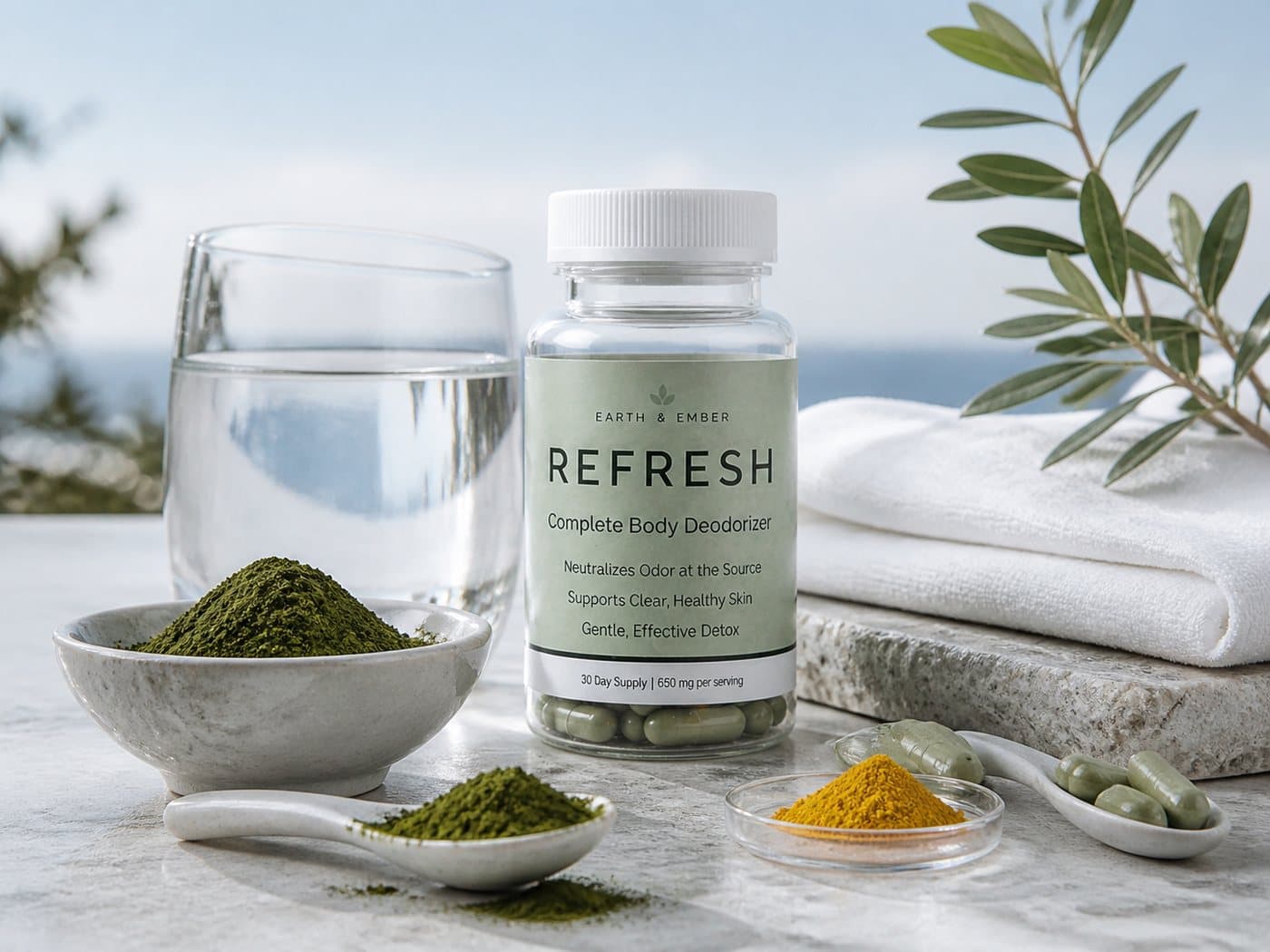
REFRESH is custom-formulated around six active ingredients, each with a visible dose and a clear role. When the formula evolves, the change is named.
That standard is the actual product behind the product. The capsule is one expression of it. The decision to keep iterating is another.
If the formula in your bottle ever changes, you should be able to tell us, in a single email, why. That is the pledge. It is also the version of accountability the category does not always offer.
The reason this matters is that an ingestible asks for trust in a way a topical does not. The bottle goes in the body. The standard behind it has to hold steady when the market gets loud.
The honest version of formulation work is also slow. We would rather take longer to add an active than rush a label change for a calendar. The customer reading this in a year should be able to look back at this article, compare it to the formula in the bottle, and find the line of reasoning intact.